
Teach English in Cambodia
The Ultimate Guide to Salaries, Visas, and the "Kingdom of Wonder."
Those looking to teach English in Cambodia are stepping into arguably the most exciting and accessible TEFL frontier in Southeast Asia right now. Unlike the heavily regulated markets of South Korea or Japan, Cambodia remains refreshingly open. With a rapidly developing economy and a young population hungry for global connection, the demand for English teachers here isn't just growing—it’s exploding.
What’s more, the "Kingdom of Wonder" lives up to its name. You’ll be based in a land that feels like a true adventure, from the chaotic charm of Phnom Penh’s riverside markets to the ancient, moss-covered stones of Angkor Wat. On weekends, you have the Cardamom Mountains for trekking and the untouched islands of Koh Rong for white-sand escapism. Oh, and you’ll be living in the geographic heart of Indochina, with Vietnam, Thailand, and Laos just a short bus ride away.
This guide runs through the ins and outs of what it means to teach English in Cambodia. It’s got info on everything from the TEFL jobs market to the surprisingly high savings potential. Oh, and there are some top tips on the best places to go looking for jobs in this land of saffron robes and smiles.
Quick Facts
What’s in this guide?
Jump to any section below. This is a full, start-to-finish guide — jobs, requirements, visas, salary, and the realities of living in Cambodia.
- The TEFL jobs market in Cambodia
- Types of English teaching jobs in Cambodia
- TEFL teacher salary in Cambodia
- Visas for teaching in Cambodia
- Requirements to teach English in Cambodia
- Working hours & typical schedules
- Cost of living in Cambodia
- Where to teach in Cambodia
- How to get a job in Cambodia
- FAQs
The TEFL jobs market in Cambodia
Cambodia is increasingly becoming one of the most intriguing economies in Southeast Asia. For decades, it was overshadowed by its powerful neighbors, Thailand and Vietnam. However, with a consistent GDP growth rate hovering around 7% for much of the last decade, Cambodia is developing at a breakneck pace. This has created a surging demand for English education as the country integrates deeper into the ASEAN economic community.
The upside? The demand for teachers is extremely high, and the barriers to entry are significantly lower than in more developed Asian markets. In fact, Cambodia remains one of the few places in the world where you can legally secure a work permit without a university degree, provided you have a recognized TEFL certificate. This makes it the premier destination for gap-year travelers, career changers, and those without a Bachelor's degree.
But there is a reality check. Cambodia is still a developing nation. While cities like Phnom Penh are modernizing rapidly with skyscrapers and malls, infrastructure in smaller towns can be raw. The teaching market reflects this: it is less regulated and more "Wild West" than Japan or Korea. Flexibility and a sense of adventure are key. Most jobs are found in private language centers and international schools in the major hubs of Phnom Penh and Siem Reap, though opportunities in laid-back towns like Battambang are growing.
- Population: 16.7 million
- Language(s): Khmer (English widely used in business)
- Currency: Riel (KHR) & USD (Dual currency system)
- Capital city: Phnom Penh
- Estimated salary: $800 - $1,200+ USD
- Public Holidays: 23 days (Among highest in world)
- Climate: Tropical (Wet & Dry seasons)
- Main Transport: Tuk-tuks & PassApp
- Internet: Fiber & 4G widely available
Types of English teaching jobs in Cambodia
From flexible language centers to structured international schools, here is where you will find work.
Private Language Centers
The most common employer. These centers cater to children and adults after school/work hours. They offer the easiest entry point for new teachers and often hire year-round.
International Schools
The highest-paid tier. These schools follow Western curriculums (IB, American, British). They require more qualifications but offer paid holidays and stable M-F schedules.
Universities
A growing sector for qualified teachers. Universities in Phnom Penh hire lecturers for English communication courses. It's prestigious but pay can vary wildly based on hours.
Private Tutoring
Many teachers supplement their income with 1-on-1 tutoring. Wealthy Khmer families often hire private tutors for their children to focus on conversation and homework help.
TEFL teacher salary in Cambodia
Salaries in Cambodia can vary significantly depending on your qualifications and the type of institution you work for. While a paycheck of $1,000 - $1,200 USD might look modest compared to South Korea or the Middle East, it is vital to view this through the lens of purchasing power. In a country where a delicious local meal costs $1.50 and a modern apartment can be rented for $250, that salary affords a very comfortable lifestyle with room for savings.
Typically, teachers without a degree or extensive experience will start at the lower end of the spectrum in private language centers. These roles are often paid hourly. If you treat it like a full-time job and pick up 25-30 hours a week, you can comfortably clear $1,000+.
For those with a Bachelor's degree and a TEFL certificate, the doors to International Schools open up. These positions are salaried (not hourly), offer paid holidays, and can pay upwards of $1,500 to $3,000 per month. This puts you in the top tier of earners in the country, allowing for a lifestyle that includes regular travel, dining out, and saving a substantial "nest egg" of $500+ per month.
Salary Breakdown (USD)
| Entry Level / No Degree | $800 - $1,000 |
| Language Centers | $1,000 - $1,200 |
| International Schools | $1,500 - $2,500+ |
| Hourly Rate | $10 - $14 / hr |
| Private Tutoring | $15 - $20 / hr |
Visas for teaching in Cambodia
Visas are arguably the biggest selling point for teaching in Cambodia. Unlike China or Thailand, which require a mountain of paperwork to be notarized and authenticated in your home country before you even step on a plane, Cambodia allows you to sort everything out upon arrival. This makes it the most accessible entry point for new teachers in Asia.
However, there is one golden rule: Do not enter on a Tourist (T-Class) Visa. If you enter on a Tourist Visa, it cannot be renewed for work purposes, and you will likely have to leave the country and re-enter.
Pro Tip: The E-Class Visa
Always ask for the "Ordinary" or "E-Class" Visa when you arrive at the airport in Phnom Penh or Siem Reap. It costs approximately $35. This is the only visa type that can be legally extended for employment purposes.
Once you have entered on the E-Class visa, you will have 30 days to find a job. Once employed, your school will provide you with a letter of employment and help you apply for the EB Business Extension (usually for 6 or 12 months). This extension gives you legal residency and multiple-entry privileges.
Finally, to be 100% legal, you will also need a Work Permit. This is a separate physical card issued by the Ministry of Labour. Your school is responsible for helping you register for this, though the fees (approx. $100/year) are sometimes deducted from your salary or paid by you directly, depending on your contract.
Requirements to teach English in Cambodia

Cambodia is one of the most competitive TEFL markets in terms of hiring flexibility. You do not need a degree to legally teach here, but you do need professionalism and certification.
- A TEFL qualification This is non-negotiable. You simply must have at least a 120-hour TEFL qualification, preferably from an industry-accredited provider. This is the key document for your Work Permit.
- A clean criminal background check Schools and the Ministry of Labour require a recent background check from your home country to ensure child safety standards.
- A college degree (Optional) Unlike Thailand or Vietnam, a Bachelor's degree is NOT required for a legal work permit in Cambodia. However, having one will open doors to higher-paying International Schools.
- Native or Near-Native English While "Big 7" passport holders are preferred, fluent non-native speakers with a neutral accent and a strong TEFL certificate are frequently hired.
Term times and working hours in Cambodia
The education sector in Cambodia is split into two distinct calendars. The public school year typically begins in November and runs until August, with a long holiday break for Khmer New Year in April. If you secure a job in a public school or a large international school, you will follow this rhythm, enjoying significant paid downtime during the major festivals.
23 Public Holidays per Year
Cambodia has one of the highest numbers of public holidays in the world. From the Water Festival (Bon Om Touk) to Pchum Ben (Ancestors' Day), you will have plenty of 3-day weekends to explore the country.
Private language centers, however, operate year-round to cater to students after their public school classes. In these roles, terms are often rolling, meaning you can be hired at any time of the year. Working hours in language centers are typically "antisocial"—meaning evenings (5:30 PM – 8:30 PM) and weekends (Saturday/Sunday full days). The trade-off is that you have your mornings and weekdays free to enjoy the low-traffic hours at gyms, cafes, and markets.
Cost of living in Cambodia
The low cost of living is the primary reason teachers choose Cambodia. While salaries may be lower than in Japan or South Korea, your purchasing power is significantly higher. You can rent a modern, serviced apartment in the heart of Phnom Penh for a fraction of what you would pay in Bangkok. In smaller hubs like Kampot or Battambang, you can find comfortable accommodation for as little as $150 a month.
Eating out is a way of life here. A local Khmer meal of Bai Sach Chrouk (pork and rice) can cost as little as $1.50, while a high-end Western dinner with drinks might set you back $15. This allows for a social lifestyle that simply isn't possible on a teacher's salary in the West.
However, it is important to budget for "Western comforts." Imported goods like cheese, wine, and brand-name electronics are taxed heavily and can be more expensive than at home. Living like a local is the key to saving big.
Monthly Budget (Single Teacher)
| Rent (Studio Apartment) | $150 - $400 |
| Utilities (Elec/Water/Wifi) | $60 - $100 |
| Food & Drink | $200 - $300 |
| Transport (PassApp) | $30 - $50 |
| Entertainment | $100 - $150 |
Where to teach English in Cambodia?
Cambodia offers something that a lot of TEFL destinations can’t: A seamless blend of ancient wonders and tropical island life. Even if you’re based in the bustling capital of Phnom Penh, you’ll never be far from the awe-inspiring temples of Angkor Wat or the pristine white sands of Koh Rong. On top of that, you’ve got some of the warmest hospitality in Southeast Asia, incredible Khmer cuisine, and a low cost of living that allows for a great quality of life. It’s easy to see why so many want to teach English in Cambodia each year.
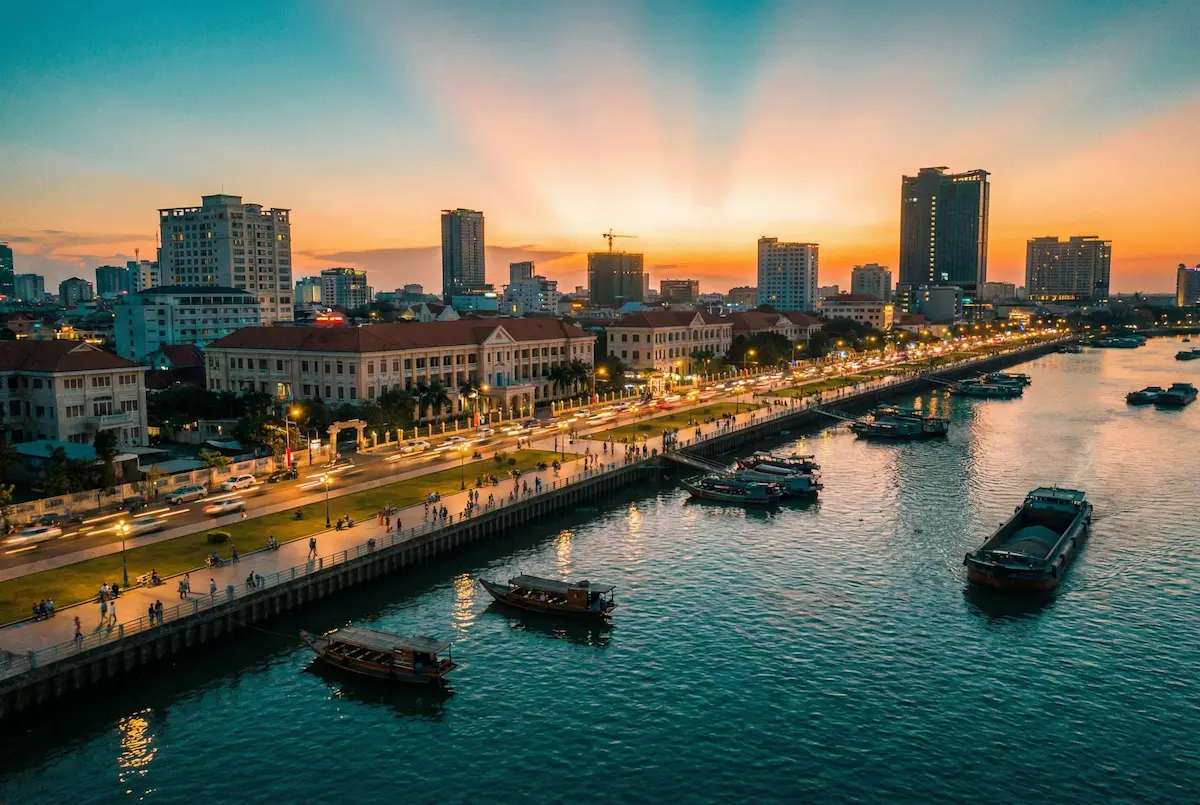
Urban Energy
Riverside promenades, booming cafe culture, vibrant markets, and a mix of modern and colonial history.

History & Culture
World-famous ancient temples, artistic communities, colonial architecture, and relaxed vibes.
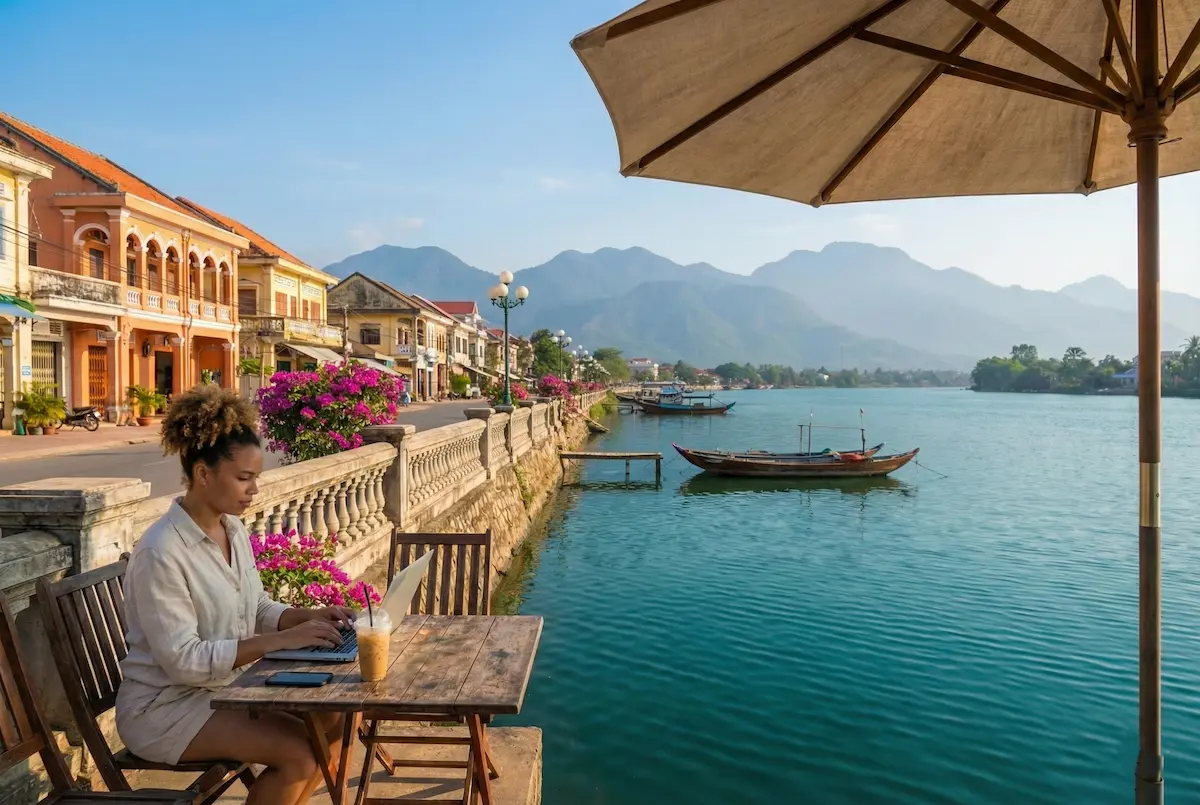
River & Coast
Laid-back riverside sunsets, pepper plantations, fresh crab markets, and nearby islands.
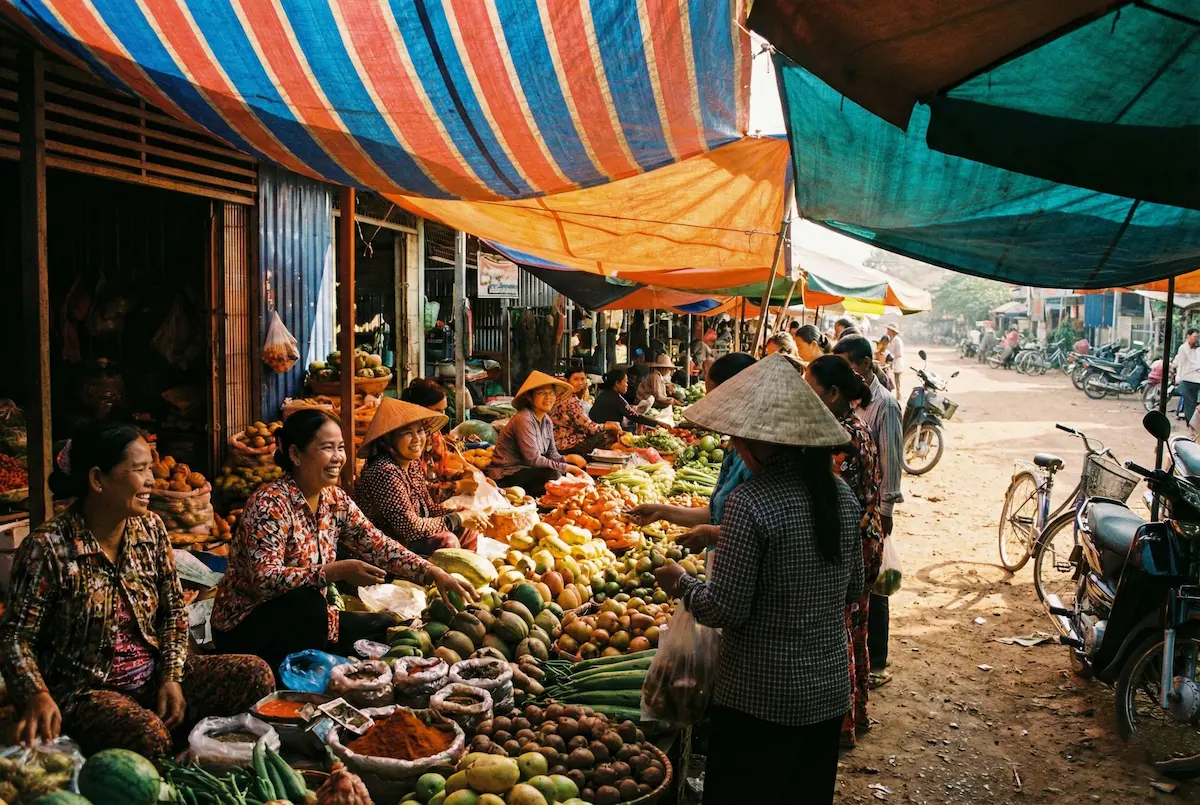
Authentic Cambodia
Immersive community living, very low cost of living, and the "real" Khmer experience.
How to get a job in Cambodia
Unlike other Asian markets like Korea or Japan, Cambodia operates largely on a "face-to-face" hiring basis. Schools rarely hire from abroad unless you go through a dedicated program. This leaves you with two distinct paths:
The DIY Route
For the adventurous teacher. You get certified at home, fly to Phnom Penh, and hit the pavement handing out CVs.
- Flexibility: Choose your own city/school.
- Cost: Only pay for the course & flight.
- Hiring: Interviews must be done in-country.
- Logistics: You manage accommodation & visas.
The Internship Route
The safe, supported landing. We secure your job before you leave and handle the logistics so you can focus on teaching.
- Job Secured: Contract signed pre-departure.
- Soft Landing: Airport pickup & orientation.
- Community: Arrive with a group of peers.
- Visa Support: Full legal assistance.
Frequently Asked Questions
Crucial info for the 2026 Cambodia teaching landscape.